After finishing Bill Bryson's 'A Short History of Nearly Everything', I wanted to find out more about the palaeontologists he had discussed in one of his chapters. In particular, I had been enthralled by the rivalry between Richard Owen and Charles Lyle. I looked in the bibliography for Bryson's book and Christopher McGowan's The Dragon Seekers looked to be the viable option for finding out more without breaking the bank.
McGowan, a geologist himself, writes a clear and measured account of the lives and careers of the most notable geologists of the nineteenth century, starting with Mary Anning, arguably one of the most important and influential women in scientific history. From then on, however, the figures discussed become very much a boy's own club, with biographies of Owen, Lyell and the frankly mental Dr Buckland. Darwin enters the fray towards the book's conclusion and we learn of the influence his mentor, Owen, had on his theory of evolution (despite his influence, Darwin was forced to keep his ideas quiet around Owen, who vehemently opposed the idea of the transmutation of species).
The book describes science by way of history and also adds social context and information about political arguments of the time, providing the reader with an unfussy, accurate account of the lives and times of these extraordinary people. Unfortunately, the book is somewhat dry throughout and there are fewer madcap anecdotes than Bryson had led me to believe.
However, anyone with more than a passing interest in geology, dinosaurs, the history of scientific enquiry, palaeontology, evolution and social structures in the nineteenth century should find this book interesting and enlightening. And that surely encompasses most people, right?
Tuesday, 30 November 2010

Stephen King’s ‘The Stand’
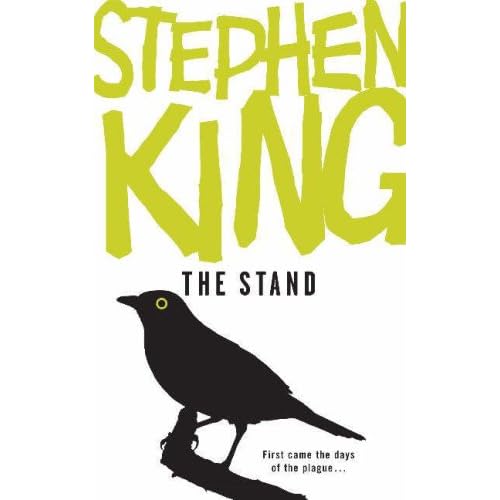
 According to the writers themselves, ‘The Stand’ was a massive influence on Lost, which was basically my only reason for picking up and reading the 1,300 page novel. As a huge Lost fan, I was both curious to see for myself the extent of the book’s influence on the show and eager to immerse myself in a similar world now that the programme has ended.
‘The Stand’, set in the USA and in my edition at least, the early 1990s (King has updated his novel on at least two previous occasions since its original publication in the late 70s; mine is the ‘uncut’ and presumably final edition) and is told in three parts. The first recounts the destruction of much of the human race after a biological weapon, the so-called super flu, is accidently exposed to the populace and of the consequential breakdown of society. The second describes how the naturally immune survivors (less than one per cent of the population) are influenced by dreams to be drawn towards either the devoutly Christian Mother Abagail or the demonic Randall Flagg and form communities in Boulder, Colorado and Las Vegas, Nevada respectively. The final part concerns the titular Stand as the two communities are together in conflict.
Similarities to Lost are both broad and specific. The overriding themes of good versus evil and the challenge of survival are predominant in both, but there are also finer points – a speech about the dangers of dynamite was repeated almost verbatim in Lost and a nuclear device proves to be a key plot point in both narratives. Even whole characters are repeated or ‘paid tribute to’, such as the pregnant Fran Goldsmith being an obvious precursor to Lost’s Claire or the character arc of Larry Underwood’s one hit wonder pop star setting the template for Charlie Pace.
I enjoyed ‘The Stand’ in its own right too and was gripped within the first couple of chapters. Admittedly, many of the characters were pretty unoriginal and some of the dialogue clunks like a bowling ball dropped down a flight of stairs, but the plot was marvellously constructed and the end of the civilised world is told with unsparing detail. Though unrelenting in its bleakness at times, there are moments of hope and relief that are rewarding and cathartic. Essentially, the sad parts make you feel sad and the exciting parts make you feel excited, which is all I expected of the book – fortunately I also got extra enjoyment out of it in spades.
Thursday, 19 August 2010
'The Crossing' & 'Cities of The Plain' by Cormac McCarthy
 Hi
HiSorry for the massive delay in updating this blog. I've had a lot on over the last few weeks, including moving out of my flat, seeing friends and doing a lot of work, which hasn't left me with a whole lot of time for either reading or writing about reading. Hopefully I'll get back into the swing of it now, though no promises.
In any case, I've finally finished McCarthy's trilogy and I thoroughly enjoyed it; though as a whole, rather than the individual books. The second, 'The Crossing', sees young Billy Parham mercifully escorting a pregnant wolf he has captured back to the Mexican mountains from whence it came, rather than shooting it. That's merely the tip of the iceberg though, and a chain of events begins that sees Billy and his brother Boyd making several trips across the US/Mexican border and meeting seemingly everybody in Mexico, each of whom has a deeply philosophical story to tell.
It's one of those books where seemingly everything and nothing happens at the same time. Honestly, it was somewhat of a slog (not helped by the lengthy breaks I took in reading it), but it is certainly good enough to see through to completion. There's some fascinating ideas espoused in the narrative (the meeting with the blinded revolutionary perhaps showcsing the vest of them) and Billy is a strong protagonist, if a little similar to John Grady of the previous book, 'All the Pretty Horses'. Unlike that book though, is the greater sense of scale. Whilst John Grady's journey took place over a few months, Billy's story is spread over years and covers a wider amount of territory.
The effort put into 'The Crossing' was paid off in 'Cities of the Plain', which takes place some years after the first two books and unites the two protagonists. John Grady is now nineteen and Billy is in his late twenties. Both work on a ranch and are good friends. Trouble begins when John Grady falls in love with a prostitute with a cruel pimp and Billy is forced to help his friend get the girl out of the brothel.
The plot is perhaps a little less original than in the previous books, but it is very rewarding to see the two young men united. There's also a great deal of amusing banter in this book and the cowboy's simplistic, yet philosophical vernacular is pleasing to read. I found some of the themes and settings of this (and the preceding novels) very Springsteen-like in their telling (especially in his darker songs), which as a big Boss fan, I enjoyed very much. Like the rest of the trilogy, the book is very bleak and offers little in the way of redemption, but is well worth the investment of time and emotion required to enjoy it.
------------------------------------------------------------------------------------------------------------
At the moment, I'm living out of a bag of clothes at my girlfriend's house. As such, I've only brought a couple of books with me, so I've made a couple of changes to my reading list, including a new addition: The next book I'm going to start will be Stephen King's 'The Stand'. I've never read any Stephen King, but I got the book with a voucher because I heard 'Lost' ripped it off, and I love Lost.
Bye for now,
Jack
Monday, 21 June 2010
'All the Pretty Horses' by Cormac McCarthy

'All the Pretty Horses' is the first book in McCarthy's Border Trilogy, a series of novels set between the United States and Mexican frontiers. In this first book, set in the late forties, we meet John Grady Cole, a sixteen year old with a talent and passion for horses. After his home is sold, he sets off for Mexico from Texas, his friend Lacey Rawlins in tow.
On their journey, they meet the mysterious Jimmy Blevins, a young boy with a stately horse he claims belongs to him. They lose him in an altercation with some Mexicans and eventually find themselves on a ranch, where John earns his keep breaking horses and falls in love with Alejandra, the ranch owner's daughter.
I have previously enjoyed both 'No Country For Old Men' and 'The Road' by the same author and appreciated the opportunity to soak up McCarthy's beautifully sparse prose once more. Whilst not burdening himself with such trifling things such as punctuation, McCarthy's economic use of language expertly assembles the dusky vistas of his stories with aplomb. While much of what he describes is minimal, there are numerous passages of sublime eloquence in which the author describes beautifully concepts such as love, evil and horses.
I was consumed by the book and eager to rush the conclusion. The characters are well conceived and are very likeable. At times, however, I was frustrated with how mature and capable the main character was, often displaying ingenuity and resourcefulness clearly beyond his years. On some occasions, McCarthy's blunt prose jar slightly and some elements feel a little tacked on. Others may also argue that the plot is rather hackneyed or passée, but I thoroughly enjoyed it and thought it a good take on the modern western. I also enjoyed reading an earlier version of McCarthy's distinctive literary style that he would perfect in 'No Country...' and 'The Road'. I look forward to the next two volumes.
I've also just learnt that this book was adapted for film by Billy Bob Thornton, starring Matt Damon and Penelope Cruz. I shall be watching that with great interest soon!
Sunday, 13 June 2010
'A Short History of Nearly Everything' by Bill Bryson
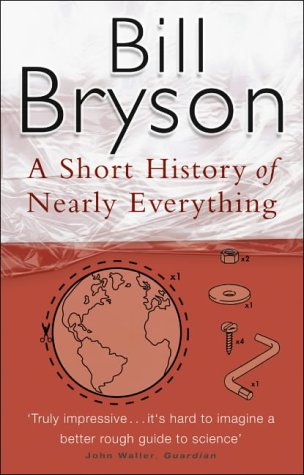

I finished reading this book not fifteen minutes ago. I thoroughly enjoyed it. It wasn't quite what I was expecting it to be - I thought it would be a history of the universe and our world, but it was more like a history of science, if you will.
Bryson discusses all the avenues of science and gives an overview how and why disciplines study what they do. The key figures of each discipline are detailed along their amusing quirks and eccentricities - of which there are many.
Having studies geology for a year at AS level, I particularly enjoyed the chapters on palaeontology and plate tectonics as Bryson reminded me of all the amazing facts about the planet geologists have often literally unearthed.
There are countless head-spinning facts and statistics to digest - Bryson's descriptions of the sheer size of the universe and the minuteness of particles are stunning. A few pages will give you plenty of interesting facts to 'impress' your friends with.
My only real criticisms are that the final chapter on extinctions seemed like a slightly less than fitting conclusion to a book with such enormous scope and that there are only two illustrated diagrams in the whole book. I would have like more. Then again, the book is more of a starting point for science - it makes for a great introduction to the disciplines which further reading will provide more dense detail. Not that Bryson skimps - information practically oozes from its pages. A satisfying and enlightening read.
Friday, 4 June 2010
'Sum' by David Eagleman


Hi
Having finished 'The Book of Dave', I've been cracking on with Bill Bryson's 'A Short History of Nearly Everything'. I'm about halfway through and I'm enjoying it very much. It keeps reminding me of things I learnt in science and geology from school and college. There's an interesting passage about the warring palaeontologists Richard Owen and Gideon Mantell, which, if I'm feeling pretentious enough, I might write about at some point.
In any case, being only halfway through, I'm not going to talk about the Bryson book yet, but rather David Eagleman's 'Sum', a book I read shortly before embarking on my summer reading list. 'Sum' is a short collection of even shorter stories, each detailing different imaginings of the afterlife. For example, in one version of the afterlife, we discover god is a microbe. In another, life is found to be a simulation designed by aliens. There are thirty-eight other episodes - read the first (and an interview with Eagleman) here.
The best thing about 'Sum' is undoubtedly the sheer variety and depth of the author's creativity. The book has been embraced by the religious and atheist communities equally and perhaps best serves to demonstrate precisely that no one has any idea what happens after death and how anything could be possible. Eagleman's imagination becomes almost addictive and I found myself eagerly reading to see what the neuroscientist would come up with next.
There's a touch of the eccentric creativity of Douglas Adams, Grant Naylor or Scott Adams' 'God's Debris' and if you've enjoyed anything they've written, you'll almost definitely appreciate 'Sum'. The book is very short - each story lasts approximately two pages - so if you're in need of a quick head-spin, look no further.
Saturday, 29 May 2010
'The Book of Dave' by Will Self

I got this ages ago, and frankly I should have read it a heck of a lot quicker than I did. I had a lot of work to do in the last six weeks or so what with my dissertation and portfolio of essays being handed in for the end of term, which obviously hindered my reading time. Also, the book was fairly difficult to slog through, being partly set in the future and with much of the dialogue being written in dialect that has evolved from Cockney. There was a glossary of terms at the back! There's also a lot of jumping back and forth between lots of different time zones. It's not a particularly easy read (and I consider myself a very strong reader), but it's complexity is rewarding.
The book concerns Dave, a racist, sexist, foul-mouthed cabbie who loses his son in a messy divorce. In a mania, he writes his confused ramblings in a book and buries it in his son's garden. Hundreds of years later, after flood waters have reduced England to a near medieval state, his book is discovered, mistaken for holy scripture and forms the basis of a repressive, misogynist religion. The narrative switches between Dave in the twentieth and early twenty-first century and the characters of Symun, Carl and Antone in the far distant future.
The book is incredibly inventive and darkly humorous. There are many interesting themes, though the predominant ones are the role of religion in society and the changing face of father-son relationships in modern families.
I thoroughly enjoyed the book, despite my initial struggle to get into it (kind of like how 'Trainspotting' takes a chapter or so to get into the dialect, though this takes longer). I'll definitely be reading more Will Self in the future and I'd recommend this book to anyone who likes a big, inventive novel and Swift-ian satire.
Subscribe to:
Comments (Atom)