Monday, 21 June 2010

'All the Pretty Horses' by Cormac McCarthy


'All the Pretty Horses' is the first book in McCarthy's Border Trilogy, a series of novels set between the United States and Mexican frontiers. In this first book, set in the late forties, we meet John Grady Cole, a sixteen year old with a talent and passion for horses. After his home is sold, he sets off for Mexico from Texas, his friend Lacey Rawlins in tow.

On their journey, they meet the mysterious Jimmy Blevins, a young boy with a stately horse he claims belongs to him. They lose him in an altercation with some Mexicans and eventually find themselves on a ranch, where John earns his keep breaking horses and falls in love with Alejandra, the ranch owner's daughter.

I have previously enjoyed both 'No Country For Old Men' and 'The Road' by the same author and appreciated the opportunity to soak up McCarthy's beautifully sparse prose once more. Whilst not burdening himself with such trifling things such as punctuation, McCarthy's economic use of language expertly assembles the dusky vistas of his stories with aplomb. While much of what he describes is minimal, there are numerous passages of sublime eloquence in which the author describes beautifully concepts such as love, evil and horses.

I was consumed by the book and eager to rush the conclusion. The characters are well conceived and are very likeable. At times, however, I was frustrated with how mature and capable the main character was, often displaying ingenuity and resourcefulness clearly beyond his years. On some occasions, McCarthy's blunt prose jar slightly and some elements feel a little tacked on. Others may also argue that the plot is rather hackneyed or passée, but I thoroughly enjoyed it and thought it a good take on the modern western. I also enjoyed reading an earlier version of McCarthy's distinctive literary style that he would perfect in 'No Country...' and 'The Road'. I look forward to the next two volumes.

I've also just learnt that this book was adapted for film by Billy Bob Thornton, starring Matt Damon and Penelope Cruz. I shall be watching that with great interest soon!

Sunday, 13 June 2010

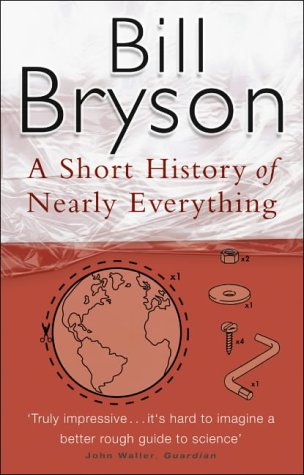
'A Short History of Nearly Everything' by Bill Bryson


I finished reading this book not fifteen minutes ago. I thoroughly enjoyed it. It wasn't quite what I was expecting it to be - I thought it would be a history of the universe and our world, but it was more like a history of science, if you will.

Bryson discusses all the avenues of science and gives an overview how and why disciplines study what they do. The key figures of each discipline are detailed along their amusing quirks and eccentricities - of which there are many.

Having studies geology for a year at AS level, I particularly enjoyed the chapters on palaeontology and plate tectonics as Bryson reminded me of all the amazing facts about the planet geologists have often literally unearthed.

There are countless head-spinning facts and statistics to digest - Bryson's descriptions of the sheer size of the universe and the minuteness of particles are stunning. A few pages will give you plenty of interesting facts to 'impress' your friends with.

My only real criticisms are that the final chapter on extinctions seemed like a slightly less than fitting conclusion to a book with such enormous scope and that there are only two illustrated diagrams in the whole book. I would have like more. Then again, the book is more of a starting point for science - it makes for a great introduction to the disciplines which further reading will provide more dense detail. Not that Bryson skimps - information practically oozes from its pages. A satisfying and enlightening read.

Friday, 4 June 2010

'Sum' by David Eagleman


Hi

Having finished 'The Book of Dave', I've been cracking on with Bill Bryson's 'A Short History of Nearly Everything'. I'm about halfway through and I'm enjoying it very much. It keeps reminding me of things I learnt in science and geology from school and college. There's an interesting passage about the warring palaeontologists Richard Owen and Gideon Mantell, which, if I'm feeling pretentious enough, I might write about at some point.

In any case, being only halfway through, I'm not going to talk about the Bryson book yet, but rather David Eagleman's 'Sum', a book I read shortly before embarking on my summer reading list. 'Sum' is a short collection of even shorter stories, each detailing different imaginings of the afterlife. For example, in one version of the afterlife, we discover god is a microbe. In another, life is found to be a simulation designed by aliens. There are thirty-eight other episodes - read the first (and an interview with Eagleman) here.

The best thing about 'Sum' is undoubtedly the sheer variety and depth of the author's creativity. The book has been embraced by the religious and atheist communities equally and perhaps best serves to demonstrate precisely that no one has any idea what happens after death and how anything could be possible. Eagleman's imagination becomes almost addictive and I found myself eagerly reading to see what the neuroscientist would come up with next.

There's a touch of the eccentric creativity of Douglas Adams, Grant Naylor or Scott Adams' 'God's Debris' and if you've enjoyed anything they've written, you'll almost definitely appreciate 'Sum'. The book is very short - each story lasts approximately two pages - so if you're in need of a quick head-spin, look no further.