After finishing Bill Bryson's 'A Short History of Nearly Everything', I wanted to find out more about the palaeontologists he had discussed in one of his chapters. In particular, I had been enthralled by the rivalry between Richard Owen and Charles Lyle. I looked in the bibliography for Bryson's book and Christopher McGowan's The Dragon Seekers looked to be the viable option for finding out more without breaking the bank.
McGowan, a geologist himself, writes a clear and measured account of the lives and careers of the most notable geologists of the nineteenth century, starting with Mary Anning, arguably one of the most important and influential women in scientific history. From then on, however, the figures discussed become very much a boy's own club, with biographies of Owen, Lyell and the frankly mental Dr Buckland. Darwin enters the fray towards the book's conclusion and we learn of the influence his mentor, Owen, had on his theory of evolution (despite his influence, Darwin was forced to keep his ideas quiet around Owen, who vehemently opposed the idea of the transmutation of species).
The book describes science by way of history and also adds social context and information about political arguments of the time, providing the reader with an unfussy, accurate account of the lives and times of these extraordinary people. Unfortunately, the book is somewhat dry throughout and there are fewer madcap anecdotes than Bryson had led me to believe.
However, anyone with more than a passing interest in geology, dinosaurs, the history of scientific enquiry, palaeontology, evolution and social structures in the nineteenth century should find this book interesting and enlightening. And that surely encompasses most people, right?
Tuesday, 30 November 2010

Stephen King’s ‘The Stand’
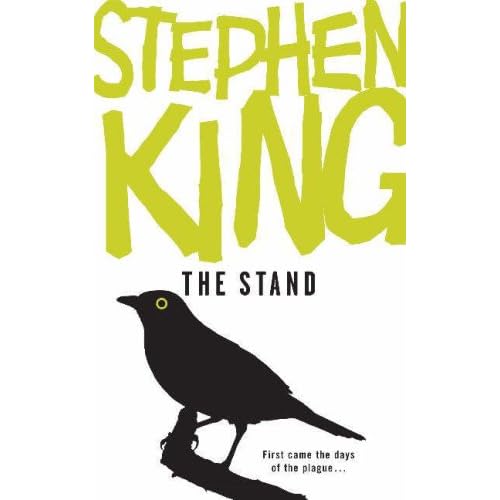
 According to the writers themselves, ‘The Stand’ was a massive influence on Lost, which was basically my only reason for picking up and reading the 1,300 page novel. As a huge Lost fan, I was both curious to see for myself the extent of the book’s influence on the show and eager to immerse myself in a similar world now that the programme has ended.
‘The Stand’, set in the USA and in my edition at least, the early 1990s (King has updated his novel on at least two previous occasions since its original publication in the late 70s; mine is the ‘uncut’ and presumably final edition) and is told in three parts. The first recounts the destruction of much of the human race after a biological weapon, the so-called super flu, is accidently exposed to the populace and of the consequential breakdown of society. The second describes how the naturally immune survivors (less than one per cent of the population) are influenced by dreams to be drawn towards either the devoutly Christian Mother Abagail or the demonic Randall Flagg and form communities in Boulder, Colorado and Las Vegas, Nevada respectively. The final part concerns the titular Stand as the two communities are together in conflict.
Similarities to Lost are both broad and specific. The overriding themes of good versus evil and the challenge of survival are predominant in both, but there are also finer points – a speech about the dangers of dynamite was repeated almost verbatim in Lost and a nuclear device proves to be a key plot point in both narratives. Even whole characters are repeated or ‘paid tribute to’, such as the pregnant Fran Goldsmith being an obvious precursor to Lost’s Claire or the character arc of Larry Underwood’s one hit wonder pop star setting the template for Charlie Pace.
I enjoyed ‘The Stand’ in its own right too and was gripped within the first couple of chapters. Admittedly, many of the characters were pretty unoriginal and some of the dialogue clunks like a bowling ball dropped down a flight of stairs, but the plot was marvellously constructed and the end of the civilised world is told with unsparing detail. Though unrelenting in its bleakness at times, there are moments of hope and relief that are rewarding and cathartic. Essentially, the sad parts make you feel sad and the exciting parts make you feel excited, which is all I expected of the book – fortunately I also got extra enjoyment out of it in spades.
Subscribe to:
Comments (Atom)